
MON - SAT: 09:30 - 06:00 PM
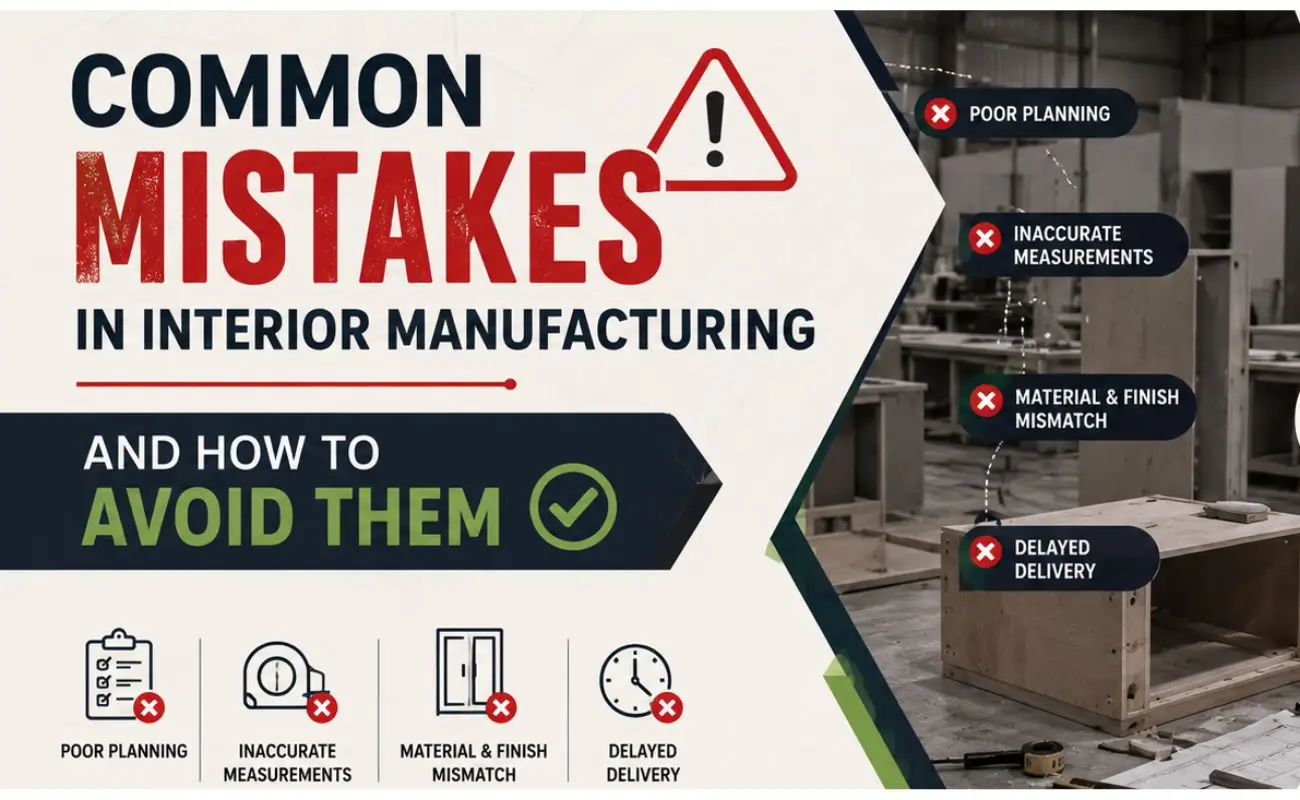
Interior spaces are often judged by their appearance, but their long-term value depends largely on what happens behind the scenes during manufacturing. A beautifully designed wardrobe, kitchen, or office workstation can quickly lose its appeal if manufacturing standards are compromised. From inaccurate measurements to poor material selection, even minor errors can lead to expensive corrections, project delays, and dissatisfied clients.
As Kerala's demand for customized interiors continues to grow, the role of a reliable Interior Design Manufacturing Company in Kerala has become increasingly important. Companies that combine design expertise with precise manufacturing practices help ensure that interior projects achieve both aesthetic excellence and lasting durability. Firms such as Cypress Interiors contribute to this evolving landscape by emphasizing structured manufacturing processes and quality-driven execution.
Interior manufacturing is the process of transforming approved interior designs into physical products and components ready for installation. It involves the production of furniture, cabinetry, partitions, wall panels, storage systems, and various customized interior elements.
The process bridges the gap between design concepts and real-world execution. Every measurement, material, finish, and hardware component must align perfectly with the approved design to achieve the desired outcome.
Interior manufacturing typically includes:
Design interpretation
Technical drawing preparation
Material procurement
Fabrication and assembly
Finishing and polishing
Quality inspection
Site installation
Without proper manufacturing practices, even the most impressive design concepts may fail to deliver expected results.
Quality manufacturing is the foundation of a successful interior project. It affects not only visual appeal but also functionality, durability, and user experience.
High-quality manufacturing ensures furniture and interior elements withstand daily wear and tear for years.
Accurate fabrication creates seamless finishes, precise alignments, and uniform appearances across the project.
Properly manufactured components operate smoothly, whether it's a modular kitchen drawer, wardrobe shutter, or office workstation.
Products manufactured with precision require fewer repairs and replacements over time.
When interiors look and perform exactly as expected, customer confidence naturally increases.
Manufacturing errors rarely occur because of a single issue. Most problems emerge from a combination of planning gaps, communication failures, and process inefficiencies.
Common causes include:
Incomplete project documentation
Miscommunication between designers and production teams
Incorrect site measurements
Inadequate material inspection
Lack of skilled supervision
Tight project deadlines
Insufficient quality control procedures
Poor coordination during installation
Identifying these causes early helps prevent costly mistakes later in the project lifecycle.
Measurements form the foundation of every manufacturing decision.
Rushed site visits
Manual measurement errors
Ignoring structural irregularities
Components fail to fit properly
Installation delays
Additional fabrication costs
Conduct multiple measurement verifications
Use digital measuring tools
Cross-check dimensions before production begins
Not all materials perform equally in every environment.
Cost-focused decisions
Lack of technical knowledge
Ignoring environmental factors
Premature deterioration
Warping and swelling
Increased maintenance
Evaluate material suitability carefully
Consider humidity, temperature, and usage conditions
Source materials from trusted suppliers
Kerala's climate presents unique manufacturing challenges.
Failure to assess moisture exposure
Inadequate material conditioning
Expansion and contraction issues
Surface damage
Structural instability
Use moisture-resistant materials where required
Store materials under controlled conditions
Account for environmental factors during planning
A well-designed project can suffer when production lacks structure.
Unrealistic timelines
Resource shortages
Inefficient scheduling
Missed deadlines
Workflow interruptions
Increased operational costs
Create detailed production schedules
Monitor milestones regularly
Allocate resources strategically
Quality cannot be inspected into a product at the end; it must be built throughout the process.
Inconsistent inspections
Absence of standard operating procedures
Defective products reaching the installation stage
Customer complaints
Rework expenses
Establish checkpoint inspections
Maintain documented quality standards
Train staff regularly
Design intent can be lost when information is not clearly transferred.
Incomplete drawings
Missing specifications
Poor coordination
Incorrect fabrication
Design inconsistencies
Project delays
Conduct design review meetings
Use detailed production drawings
Encourage collaboration between teams
Hardware influences both performance and longevity.
Prioritizing appearance over functionality
Inadequate product research
Frequent repairs
Poor user experience
Reduced durability
Choose hardware based on usage requirements
Verify load capacities and performance standards
Finishing quality significantly affects visual appeal.
Improper machinery settings
Lack of skilled workmanship
Visible defects
Reduced moisture resistance
Poor customer perception
Implement finishing inspections
Use quality edge-banding materials
Train operators effectively
Speed often becomes the enemy of quality.
Aggressive project schedules
Last-minute design changes
Increased errors
Inconsistent workmanship
Higher rework rates
Set realistic timelines
Incorporate contingency planning
Freeze designs before production starts
Manufactured products must fit seamlessly on-site.
Site changes after manufacturing
Poor coordination with installation teams
Installation delays
Modification costs
Customer dissatisfaction
Conduct pre-installation reviews
Verify site readiness
Maintain communication throughout the project
Error prevention is a shared responsibility.
Prepare accurate designs
Clarify specifications
Coordinate with production teams
Follow approved drawings
Maintain production accuracy
Monitor workmanship quality
Conduct regular inspections
Identify defects early
Verify compliance standards
Oversee schedules
Coordinate departments
Manage risk factors
Ensure proper fitting
Report site issues promptly
Approve designs carefully
Communicate requirements clearly
Waiting until the end of production is a costly mistake.
Quality inspections should occur at multiple stages:
Verify dimensions, materials, and specifications.
Inspect incoming materials for defects and consistency.
Monitor fabrication accuracy throughout manufacturing.
Review finished products before transportation.
Confirm proper alignment and functionality.
Conduct a comprehensive quality assessment before project completion.
Certain stages are more vulnerable to mistakes than others.
Misunderstanding drawings can affect the entire production process.
Improper storage may damage materials before fabrication begins.
Incorrect machine settings can create dimensional inaccuracies.
Poor assembly practices often lead to alignment issues.
Surface defects frequently originate during finishing.
Unexpected site conditions may create compatibility challenges.
Modern manufacturing technologies have transformed the interior industry.
Provides high-precision cutting and fabrication.
Improves design accuracy and manufacturing consistency.
Helps identify design conflicts before production begins.
Reduces human measurement errors.
Enhances repeatability and quality control.
Improves communication, scheduling, and workflow tracking.
Technology not only improves accuracy but also increases overall efficiency throughout the manufacturing process.
Manufacturing errors affect more than project budgets.
Common consequences include:
Material wastage
Additional labor expenses
Delayed project completion
Transportation losses
Customer dissatisfaction
Reputation damage
Reduced profitability
A single manufacturing error can trigger a chain reaction that affects multiple project stages. Preventive measures are often far more cost-effective than corrective actions.
Understanding the workflow helps identify where quality control should be applied.
Project goals, functional needs, and design expectations are identified.
Concepts are transformed into detailed design proposals.
Precise production drawings are prepared for manufacturing teams.
Suitable materials are chosen based on performance and aesthetics.
Production schedules and resource allocation are finalized.
Components are manufactured according to approved specifications.
Products undergo systematic quality checks.
Painting, laminating, polishing, and detailing are completed.
Manufactured components are assembled and installed.
The completed project is inspected and delivered to the client.
Professionals often rely on the following practices:
Conduct detailed site surveys before production.
Maintain updated technical documentation.
Standardize manufacturing procedures.
Use digital measurement tools whenever possible.
Perform inspections at every critical stage.
Train manufacturing staff regularly.
Invest in modern fabrication technologies.
Maintain open communication between design and production teams.
Establish accountability across departments.
Prioritize quality over speed.
Common mistakes include inaccurate measurements, poor material selection, inadequate quality control, rushed production schedules, and communication gaps between design and manufacturing teams.
Defects can be minimized through detailed planning, regular inspections, skilled supervision, accurate measurements, and the use of advanced manufacturing technologies.
Quality control helps identify issues before products reach installation, reducing rework costs, delays, and customer complaints.
Modern facilities use CNC machines, CAD/CAM software, digital measuring systems, automation tools, and project management platforms to improve accuracy and efficiency.
A professional Interior Design Manufacturing Company in Kerala typically follows structured workflows, conducts multiple quality inspections, uses precision manufacturing equipment, and maintains close coordination between design, production, and installation teams.
Conclusion
Interior manufacturing is where design ideas become tangible realities. While creativity drives interior concepts, precision manufacturing determines whether those concepts succeed in practice. From measurement accuracy and material selection to quality inspections and installation readiness, every stage plays a crucial role in delivering exceptional results.
Avoiding common manufacturing mistakes requires a combination of planning, skilled execution, technology, and continuous quality monitoring. As Kerala's interior industry continues to evolve, organizations that prioritize manufacturing excellence set higher standards for durability, functionality, and customer satisfaction. Companies such as Cypress Interiors reflect this approach by emphasizing structured manufacturing processes that help transform design visions into dependable, long-lasting interior solutions.