
MON - SAT: 09:30 - 06:00 PM
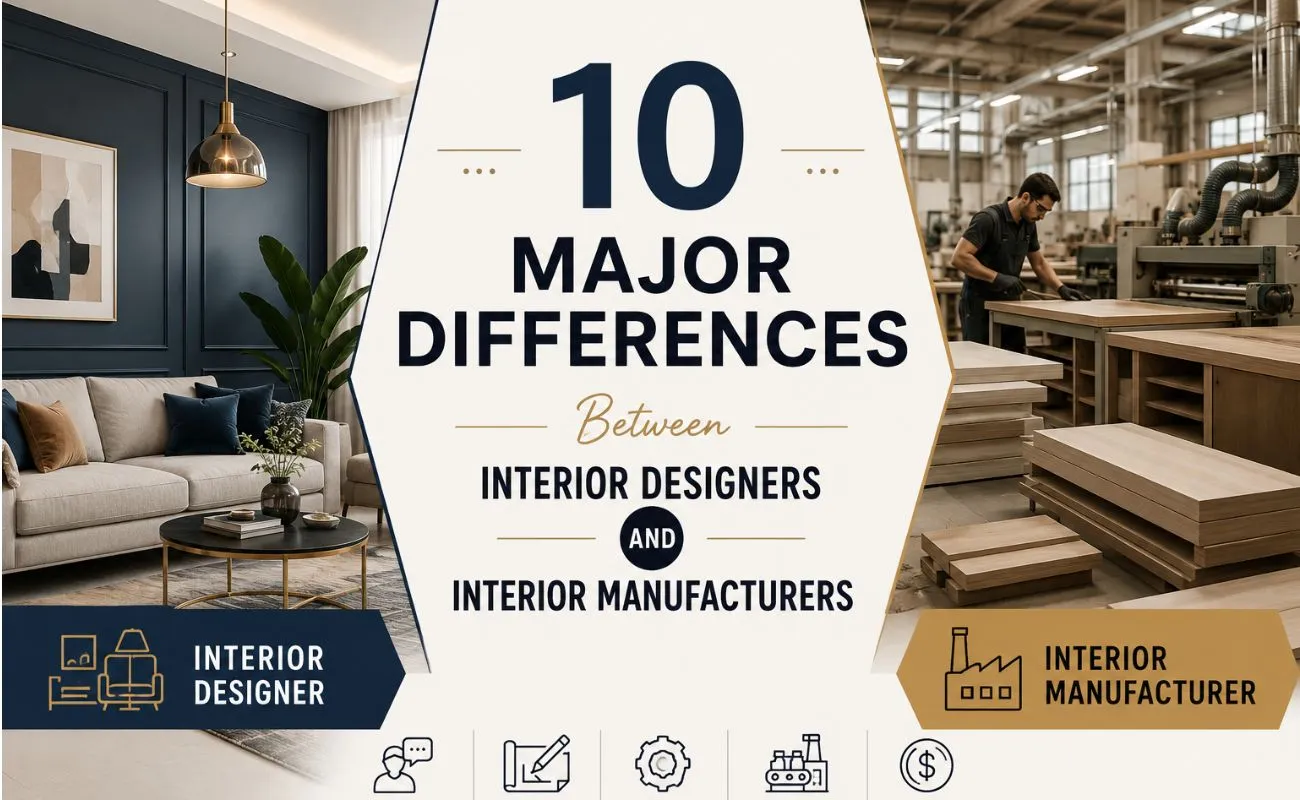
When people admire a beautifully designed home, stylish office, or luxurious commercial space, they often credit the entire transformation to an interior designer. While design plays a significant role, there is another equally important contributor working behind the scenes—the interior manufacturer. Without skilled manufacturing, even the most creative design concepts remain ideas on paper.
This confusion is common among homeowners, property developers, and business owners planning interior projects. Understanding the distinction between these two professionals helps in making informed decisions, managing budgets effectively, and ensuring smooth project execution. As the demand for customized interiors continues to grow, the role of an experienced Interior Design Manufacturing Company in Kerala has become increasingly important in converting design visions into durable and functional realities.
Companies involved in advanced interior manufacturing contribute significantly to modern projects by combining craftsmanship, technology, and precision production to support interior design goals.
An interior designer focuses on planning and conceptualizing spaces. Their objective is to create environments that are visually appealing, comfortable, and functional according to client requirements.
They work on space layouts, color schemes, material selection, lighting concepts, furniture planning, and overall aesthetics.
An interior manufacturer is responsible for producing and fabricating the physical elements required for the project. This includes modular kitchens, wardrobes, furniture, wall panels, partitions, storage systems, and custom-built interior components.
Their responsibility begins where the design concept transitions into actual production.
A designer creates the vision. A manufacturer turns that vision into reality.
Designers focus primarily on aesthetics, user experience, spatial efficiency, and visual harmony.
Their attention revolves around how a space should look and feel.
Manufacturers concentrate on production quality, structural durability, material processing, and installation accuracy.
Their focus is on how a product should be built and perform over time.
A beautiful design without quality manufacturing may fail in practical usage, while superior manufacturing without proper design may lack visual appeal.
Interior designers typically possess skills such as:
Space planning
Concept development
Color theory
Design software proficiency
Material coordination
Client presentation skills
Manufacturers require technical and production-oriented expertise, including:
Woodworking and fabrication
CNC machine operation
Material processing
Product engineering
Quality control
Installation management
Each profession demands specialized knowledge that complements the other during project execution.
Most interior designers pursue formal education in:
Interior Design
Architecture
Spatial Design
Environmental Design
These programs emphasize creativity, functionality, and design principles.
Interior manufacturers often come from backgrounds such as:
Mechanical Engineering
Industrial Production
Furniture Technology
Manufacturing Engineering
Skilled Trade Training
Their education focuses more on production processes and technical execution.
The difference in educational training explains why designers and manufacturers approach projects from distinct perspectives.
Typical responsibilities include:
Understanding client requirements
Creating layouts
Developing design concepts
Selecting finishes and materials
Preparing design presentations
Coordinating visual elements
Manufacturers handle:
Production planning
Material procurement
Fabrication
Product assembly
Quality inspection
Site installation
Project success depends on effective collaboration between both professionals.
Designers commonly use:
AutoCAD
SketchUp
Revit
3D Visualization Software
Rendering Platforms
These tools help communicate design concepts before execution.
Manufacturers rely on:
CNC Machines
Edge Banding Machines
Automated Cutting Systems
Precision Drilling Equipment
Production Management Software
These technologies ensure consistency and accuracy during manufacturing.
One set of tools creates virtual designs, while the other creates physical products.
Designers interact extensively with clients throughout the project lifecycle.
They gather requirements, discuss design preferences, present concepts, and make revisions based on feedback.
Manufacturers generally interact regarding:
Product specifications
Material options
Production timelines
Installation schedules
Quality approvals
Clients typically communicate design aspirations with designers and execution requirements with manufacturers.
Designers customize interiors based on:
Lifestyle preferences
Functional needs
Design trends
Personal tastes
Their goal is creating a unique experience.
Manufacturers customize products according to:
Dimensions
Material requirements
Structural specifications
Functional performance
Their goal is achieving precision and consistency.
Successful customization requires both creative interpretation and manufacturing expertise.
The deliverables of a designer may include:
Floor plans
Mood boards
Material specifications
Design presentations
3D visualizations
The deliverables of a manufacturer include:
Modular kitchens
Wardrobes
Storage systems
Furniture units
Decorative panels
Installed interior products
Designers deliver plans and concepts, whereas manufacturers deliver tangible products.
Designers generally charge based on:
Design consultation
Project scope
Percentage of project cost
Fixed design fees
Manufacturers calculate costs using:
Raw materials
Production complexity
Machinery usage
Labor requirements
Installation services
Understanding these pricing structures helps clients budget more accurately.
Modern interior projects are rarely successful when handled by only one side of the process.
Homeowners require thoughtful layouts and reliable manufacturing to achieve long-lasting interiors.
Offices, retail stores, and hospitality environments demand both brand-focused design and precision fabrication.
Premium projects involve complex customizations that require seamless coordination between designers and manufacturers.
Builders and developers depend on manufacturing capabilities to maintain consistency across multiple units while preserving design intent.
The strongest projects emerge when creative vision and manufacturing expertise work together from the beginning.
Selecting the right manufacturing partner can significantly influence project quality and timelines.
Consider the following factors:
Advanced manufacturing infrastructure
Quality assurance systems
Skilled production workforce
Material sourcing standards
Custom manufacturing capabilities
Installation expertise
Proven project portfolio
Ability to meet deadlines
An experienced Interior Design Manufacturing Company in Kerala should be capable of delivering customized solutions while maintaining consistency, durability, and craftsmanship.
Many project delays and quality issues arise because of avoidable mistakes.
Common examples include:
Assuming designers and manufacturers perform identical roles
Selecting vendors based solely on price
Ignoring manufacturing capabilities
Overlooking material quality standards
Failing to verify previous projects
Not discussing timelines clearly
Choosing aesthetics over functionality
Neglecting long-term durability considerations
Avoiding these mistakes can save considerable time, money, and frustration.
Interior designers focus on planning and aesthetics.
Interior manufacturers focus on production and execution.
Both professions require different technical expertise.
Successful projects depend on collaboration between both roles.
Manufacturing quality directly impacts durability and performance.
Advanced production technology improves precision and consistency.
Understanding the distinction helps clients make informed decisions.
Choosing a reliable manufacturing partner is crucial for project success.
Interior design and interior manufacturing are two interconnected yet distinctly different disciplines. While designers shape the creative direction of a space, manufacturers transform those concepts into practical, durable, and functional elements that people use every day. Understanding these differences allows homeowners, businesses, architects, and developers to make smarter decisions throughout the project journey.
As Kerala's interior industry continues to evolve, the importance of partnering with an experienced Interior Design Manufacturing Company in Kerala becomes increasingly evident. Organizations specializing in precision manufacturing, customization, and quality execution help bridge the gap between imagination and reality. Through advanced production capabilities and commitment to craftsmanship, companies such as Cypress Interiors continue contributing to interior projects that combine visual excellence with long-term performance.
For those planning their next interior project, exploring professional manufacturing expertise can be the first step toward achieving interiors that are both beautiful and built to last.